Parenting
Published04/27/2026
5 min read
Why is raising kids today so exhausting?
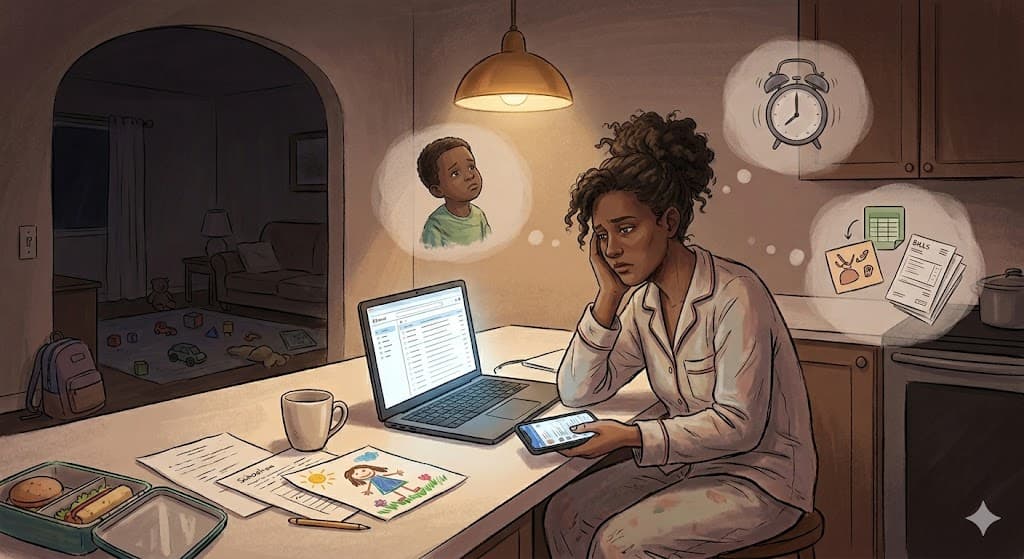
It's past 10 PM. The kids are finally asleep. You're sitting somewhere in the house, maybe at the kitchen table, maybe on the edge of the bed, and the silence that you spent all day waiting for has arrived. But instead of resting, you're catching up on work emails, or scrolling through your phone without really seeing anything, or just staring, the way you do when your brain is too tired to think but too wired to stop.
At some point today, your child asked you something, and you answered without really listening. You know it. They probably know it too. And that small moment is still sitting with you now, quietly, underneath everything else.
Tomorrow will be the same. Up before the sun, school run, traffic, a full day of performing competence at work… Maybe an evening call for that side hustle you're trying to build because the salary alone isn't stretching far enough anymore. Then home, dinner, bath time, the homework you forgot about, bedtime negotiations, and finally… this. This exact moment of exhausted stillness where you wonder, in all honesty, if you are doing enough.
You are not alone in that wondering
Something has shifted in what it means to be a parent today, especially in rapidly growing African cities. And it has happened gradually enough that it's hard to name, but heavy enough that almost every parent feels it.
The costs of everything have gone up: school fees, rent, food, transport. The kind of life you want to give your children, the kind you promised yourself you would give them, requires more money than it used to. So you work more. You hustle more. You stretch yourself further across more hours of the day, and somewhere in that stretching, the time and energy you actually have for your children gets thinner and thinner, even as everything you're doing is technically for them.
And then you come home to a child who doesn't need your money in that moment. They need you: your eyes, your attention, a parent who isn't already somewhere else in their head. That gap, between what your children need and what you have left to give by evening, is where a lot of the guilt lives.
It wasn't always like this
Or at least, it used to be much less lonely. There was a time, maybe you grew up in that era, when raising a child was something a whole network of people did together: grandparents, aunties, neighbors who knew you by name; a compound where someone was always around, where you didn't have to arrange everything and be everything yourself; Where if you were overwhelmed, there was someone to hand the baby to, not as a favor, but as a natural thing.
That world is mostly gone now, or at least very far away. Your mother is upcountry. Your sister is in another city, or another country. The neighbors in your compound or apartment block are just polite strangers. You moved to the city for opportunity, and the city gave you opportunity, but no one told that opportunity had a cost.
And now here you are, maybe just you, maybe you and a partner who is just as depleted as you are, both of you trying to divide a load that was never really meant for just two people… or one person. You’re trying to get it all right: career, income, school runs, emotional support, discipline, presence; all of it, every day, without a break that truly feels like a break.
“Why didn’t anyone tell me it was this hard?” you wonder
As if that wasn’t too much already…
And just when you thought you had enough to navigate, the world handed your children smartphones and social media and an internet that is both full of wonder and full of things you don't want them to see.
You want them to be digitally literate because that's the world they're going to live in. But you've also seen what too much screen time does: the shortened attention spans, the anxiety, the way a child can be physically in the room but completely unreachable. You've heard enough stories about the content that finds its way to children's screens to know that handing over a device is a decision that requires vigilance you don't always have the energy for.
Your parents had no template for this. Neither do you. You are making the rules up in real time, often while exhausted, and second-guessing yourself while you do it.
Here's the thing nobody says loudly enough: the reason this is so hard is not because you are doing it wrong. It's because the conditions are genuinely harder than they were for the generation before you. The costs are higher. The support is thinner. The world is faster and louder and more demanding in every direction. And parenting, real parenting, the kind that requires patience and presence and emotional availability, asks for exactly the things the rest of your life is constantly consuming.
You are not exhausted because you don't love your children enough. You are exhausted because you love them in a world that makes love expensive to show up for.
And still, you show up. Imperfectly, tiredly, sometimes distracted, sometimes short-tempered, but you show up. And that matters more than you probably give yourself credit for.
But it also raises questions that are worth sitting with honestly: In the middle of all of this, the work, the hustle, the survival, the digital noise, what does your child actually need from you that only you can give? What is being lost in the busyness, and what can still be reclaimed? How do you make parenting a real priority when everything else is fighting for that same space?