Tags
#Social Media
School was about to reopen when Luca sat his parents down. “There’s something important I need to tell you.” For any parent, those words from a quiet teenage son are enough to make your heart race. His mother’s mind went straight to worst-case scenarios ‘Did he get someone’s daughter pregnant? Did he commit a crime?’.
His father kept his face calm.
- “Alright, we’re listening,” his father said. “What is it?”
- “I’m not going back to school,” Luca said. His voice was firm.
- “What? Why?” Both parents spoke at once.
- “School is a scam. Give me the fees you were going to pay—I’ll start a business instead.”
- “What business?” his father asked, still calm.
- “I don’t know yet. I’ll figure it out.”
The parents exhaled. “Not as bad as we thought.” Within days, they’d realize how wrong they were. For over a year, Luca had been immersed in the world of a social media influencer whose entire message was "School is a scam, a waste of your time.” The idea had taken deep root. Despite pleas, arguments, and appeals from parents and relatives alike, Luca refused to return, even though he had just one trimester left before finishing secondary school and no real plan of what came next.
Let’s be honest: social media has real benefits.
Social media arrived on the African continent less than two decades ago, and its benefits are genuinely felt every day. For families, WhatsApp has been a lifeline, parents can video call a child studying in another city at a fraction of what a traditional phone call would cost. For small business owners, platforms like Facebook and Instagram have become open-air markets: a tailor in Lagos can reach customers in Nairobi without renting a single shop. And for young people, social media offers a real stage. A teenager in Accra can share their spoken-word poetry. A filmmaker in Dar es Salaam can find an audience. A dancer in Rubavu can learn new moves from across the continent. These spaces bring creativity, pride, and a sense of possibility that previous generations never had.
But the dangers are just as real and far less visible.
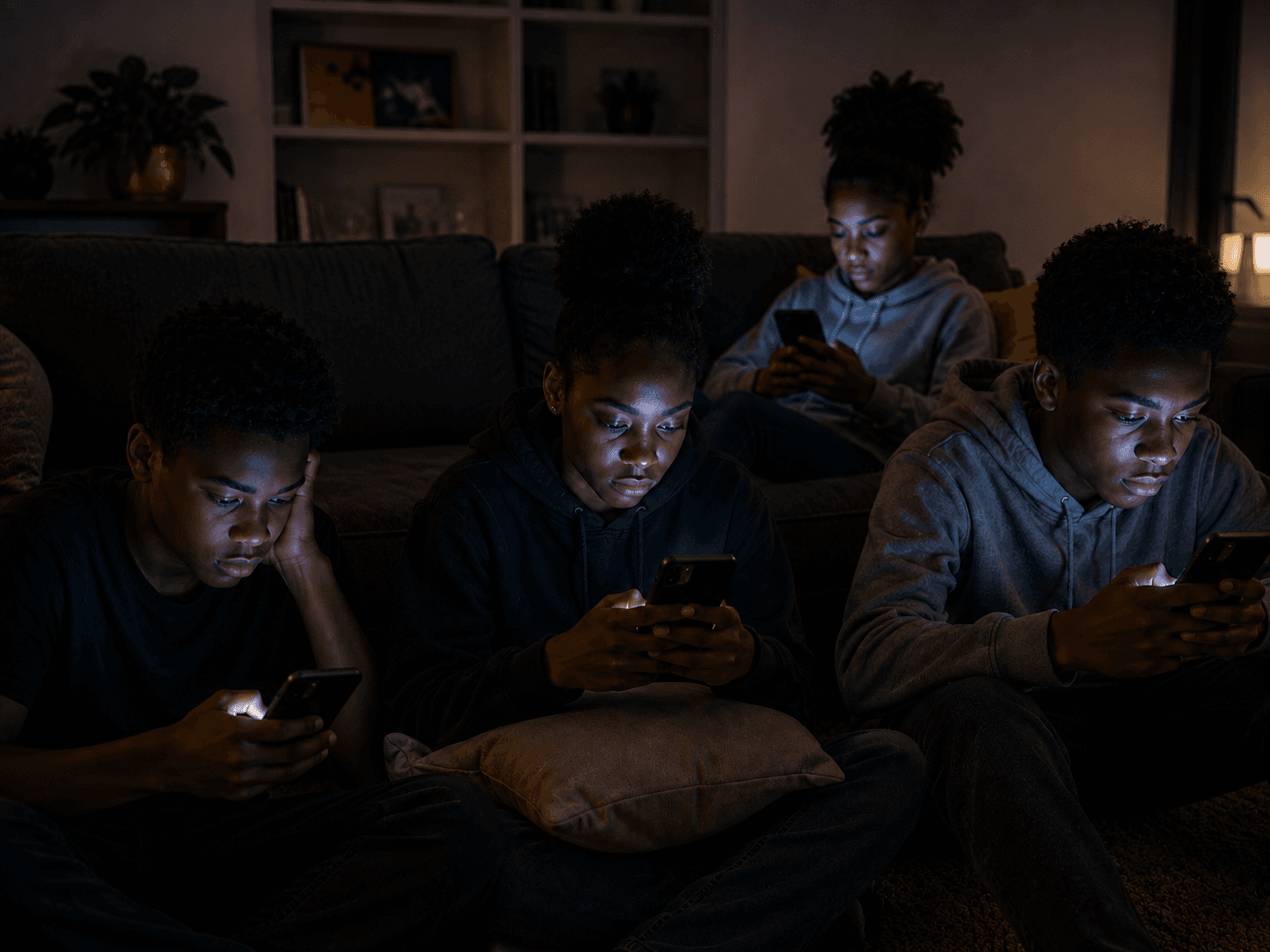
Social media platforms are engineered to be addictive, keeping teenagers hooked through infinite scroll and notification loops that disrupt sleep, fuel anxiety, and corrode self-esteem. Research has shown that heavy social media use is linked to higher risks of depression, self-harm, and suicidal thoughts among adolescents. Cyberbullying thrives in these spaces, leaving young people exposed to harassment, body shaming, and even "sextortion"—a form of blackmail where a predator tricks a teen into sharing a private, intimate image and then threatens to publicly release it unless the victim pays money or provides more explicit content—often with no adult present to intervene.
But the most insidious danger, which is also more difficult to identify, is falling prey to influencer messaging before the brain is fully developed enough to think critically. Teenagers form deep, one-sided emotional bonds with online personalities they trust like friends, not realizing that these influencers often prioritize sponsorships over honesty. Research has confirmed that influencer credibility and relatability directly shape teenagers' behaviors and attitudes, often bypassing their still-developing rational filters. The result? Teenagers chasing dangerous diet fads, wasting money on useless products, or, like Luca, making life-altering decisions based on advice from someone who never knew their name. Not because they are foolish, but because their developing brains simply aren’t yet equipped to separate genuine guidance from paid manipulation. By the time they learn to question, the damage may already be done.
How do I protect my children from the dangers of social media?
The recent landmark court cases against Meta and Google in the United States, where juries held these companies liable for addicting teenagers and causing real psychological harm, are encouraging. But they also make one thing crystal clear: for the companies behind these platforms, the safety of our children will never outweigh their profits. That means the responsibility falls on us: parents, families, and communities.
So what can we actually do? First, let’s applaud the Government of Rwanda for its recent bold ban on children under 16 from having social media accounts—experts strongly advise delaying access until at least age 16, as younger adolescents are far more vulnerable to the negative effects. In fact, more African countries should follow suit.
Second, set firm boundaries at home and be the first to follow them: implement phone-free times, such as during meals and for at least an hour before bed, and keep all devices out of the bedroom overnight to protect sleep.
Third, use parental controls: be aware of what features exist and activate them, but recognize they are not a complete solution.
Fourth, focus on real-world connection: encourage in-person social activities, sports, and hobbies that build self-esteem from real achievements, not from online validation. Human beings crave connection, when found in the real world, we’re less likely to get addicted to social media.
Finally, and most importantly, keep open communication with your teens. Talk to them about how social media makes them feel, not just how much they use it. Discuss the curated, fake nature of online content and the business model behind "likes" and "followers," because once a child understands they are the product being sold, they are already safer than most.