Tags
#Reading for Kids
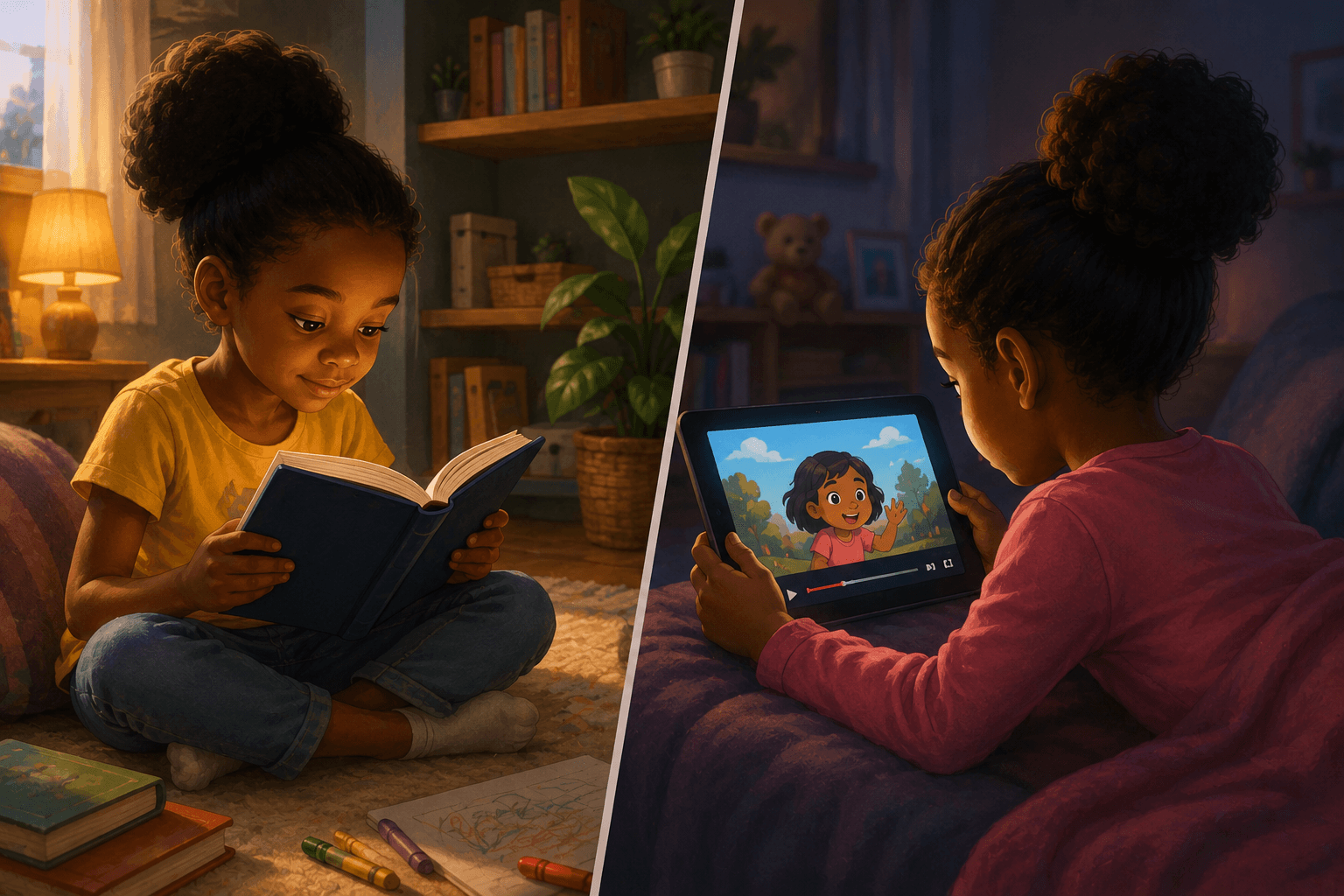
Amara is seven. She can unlock a tablet, find her favorite cartoon, and watch it, all before her mother has finished cooking dinner. She has never once, on her own, picked up a book.
Her mother, Mutoni, is not alarmed. “At least she’s learning,” she tells herself. “Everything is on YouTube these days.”
It is a thought shared by millions of parents across African cities right now. And it is worth asking, honestly: is she right? In a world where a child can watch a documentary about the human body, follow a math tutorial, or listen to a story read aloud by an animated character, does sitting down with a book still matter?
The answer, as it turns out, is a resounding “yes.” Reading is still a very important skill, and here is exactly why.
But my child learns everything from videos, why does reading still matter?
Here is something that might surprise you: reading and watching are not the same thing for the brain, even when the content is identical.
When a child reads, their brain is doing heavy lifting. It is decoding symbols, building mental images, holding information in working memory, and connecting new ideas to what it already knows, all at the same time. Research from the University of California found that reading activates significantly more areas of the brain than watching video, particularly the regions responsible for language processing, imagination, and critical thinking.
Video, by contrast, does much of that work for the child. That is not a criticism of video; it is genuinely useful for many kinds of learning. But it is a different cognitive experience.
Think of it this way: watching someone exercising will teach you the technique. But only exercising yourself will make you stronger. Reading is like exercising.
Does reading actually make children smarter, or is that just something adults say?
It is not just something adults say. A major longitudinal study published in the journal Child Development tracked children over several years and found that those who read for pleasure from an early age showed significantly higher scores in vocabulary, spelling, and math, not just reading tests, but math. Reading, it turns out, trains the kind of structured, sequential thinking that underpins numeracy.
Vocabulary is perhaps the most powerful benefit of all. Studies show that children who read regularly are exposed to far more words than those who do not. A child who reads widely will simply have more tools to think with, and more words to express what they think.
In practical terms, reading does something no AI writing tool can do for your child: it builds the thinking that comes before the writing. AI can polish a sentence, but it cannot generate an original argument, a nuanced perspective, or a well-reasoned position that was never formed in the first place. The child who reads widely arrives at the page, or the prompt, with something to say. And in a world where everyone has access to the same writing tools, the differentiator is no longer who can write cleanly. It is who has something worth saying.
My child hates reading. Could screens actually be why?
Possibly, yes. Screens, by design, are engineered to reward the brain instantly. Every scroll, every notification, every autoplay triggers a small hit of dopamine. Reading, by contrast, is slow. It asks for patience, focus, and tolerance for not knowing what happens next. For a brain that has been trained on rapid digital stimulation, a page of text can feel genuinely difficult, not because the child is not intelligent, but because their attention has been calibrated for speed.
This is not speculation. Research published in JAMA Pediatrics found that children with higher screen time at age two showed measurably lower performance in developmental tests, including language and literacy, at ages three and five.
The good news: the brain is plastic. A child who finds reading hard today can find it rewarding in six months, if the conditions are right. The difficulty is not permanent. The habit just needs to be built.
How do I actually get my child to read when screens are everywhere?
This is the real question, and the honest answer is: not by force, and not by removing screens entirely. What works is making reading feel like a choice worth making, and then making it easy to make that choice.
A few things that actually help:
- Start with what they love, not what you think they should love. A child obsessed with football who reads football biographies is still reading. The skill transfers. The habit is what matters first.
- Read alongside them, not at them. If your child sees you read, a novel, a newspaper, anything, they receive a message that reading is what adults do for pleasure, not a punishment assigned to children.
- Use the thirty-minutes-before-bed rule. No screens for thirty minutes before sleep. Books, yes. Comics, yes. The brain winds-down naturally, the sleep is better, and the habit forms.
- Do not underestimate audiobooks. For reluctant readers, hearing a story read well, can unlock a love of narrative that transfers to reading.
- Visit a library together, even once. In most African cities, public libraries or school libraries exist and are under-used. Let the child choose freely. Ownership of the choice matters enormously.
Is there a right age to start?
The brain develops reading pathways well into adolescence, and habits formed at 12 can be just as durable as those formed at 5. But earlier is genuinely better, for one simple reason: the earlier a child reads fluently, the longer they have to benefit from it before the pressures of adolescence, social media, exams, peer dynamics, compete for their attention.
Ideally, you should start at age 4 to 8, when language acquisition is at its peak and the brain is most primed to make reading feel effortless. During this period, reading stories to a child is extraordinarily powerful even before the child can read independently. They build vocabulary, narrative understanding, and most importantly, an emotional association between books and warmth, safety, and closeness with a parent.
But if your child is ten, twelve, or fifteen and has never been a reader: it is not too late. It just requires a different approach, more autonomy, more relevance, less pressure.
So, should I make my child put down the tablet?
Not necessarily. But you should make sure the tablet does not become the only thing.
Amara’s mother is not wrong that screens can teach. YouTube can be brilliant. Documentaries are genuinely educational. The question is not screens versus books; it is whether a child is developing the capacity to sit with difficulty, to focus without instant reward, to build a world in their mind from symbols on a page. That capacity is not built by watching. It is built by reading.
And in a continent where education is one of the most powerful engines of class upward mobility, where employers still prize clear thinking and clear expression, a child who developed these skills through reading is a child with a genuine advantage.